In Greek mythology, the city of Athens faced a grim fate: sending its young men and women into the Labyrinth of Crete, a vast and intricate maze designed by the genius Daedalus. At its heart lurked the Minotaur, a fearsome beast from which no one had ever escaped.
Many had tried to defeat the Minotaur. Many had strength. Many had courage. All had failed.
Then came Theseus, a hero determined to end this cycle of sacrifice. But unlike those before him, Theseus didn’t rely solely on brute force. He sought a different approach.
Before entering the Labyrinth, Theseus met Ariadne, who gave him a simple yet ingenious tool, a ball of thread. Instead of focusing only on the monster, Theseus reflected on how to solve the larger problem of the maze itself.
He tied the thread at the entrance, unwound it as he ventured deeper, and after a fierce battle, defeated the Minotaur. But his true triumph came when he followed the thread back out, escaping the Labyrinth.
This myth isn’t just about slaying monsters. It’s about reframing problems. Most saw the Minotaur as the enemy. Theseus recognized the real challenge: navigation and escape.
Critical thinking begins with problem reframing.
Strength alone had failed time and again. Intelligent solutions often come from thoughtful design. Theseus didn’t just plan his entry; he planned his exit. He anticipated second-order consequences and solved the system problem, not just the visible one.

Why Critical Thinking Matters?
As I begin another quarter supporting an incredible group of participants on their journey to sharpen their CAT (Critical Analysis and Thinking) skills, I took a moment to reflect on a question I’m often asked: How can I apply these skills to my work in innovation?
From my experience working with changemakers and entrepreneurs, I’ve seen firsthand how critical thinking functions as a superpower. It empowers you to tackle the complexities of today and the uncertainties of tomorrow, whether you are managing projects, leading change, or driving innovation.
The relevance of Critical Thinking is also backed by data. According to the latest World Economic Forum report, critical and analytical thinking are consistently ranked among the top 10 most in-demand skills, not just for today, but for 2030 and beyond.
Let’s take a step back and ask: What does critical thinking really mean?
What Is Critical Thinking?
At its core, critical thinking is about breaking things down and rebuilding them with clarity and purpose. It’s the art and science of analyzing arguments, drawing sound inferences, whether inductive or deductive, evaluating claims, and making decisions that stand up.
Critical thinking is a balance between cognitive skills and your mental habits. It’s about how you see the world, shaped by open-mindedness, curiosity, flexibility, reason, and respect for different views.
One of my favorite insights comes from Robert H. Ennis’s paper, ‘A Concept of Critical Thinking’ published in Harvard Business Review, where he defines critical thinking as “the correct assessment of statements.”
In other words, it’s about asking the right questions:
- Is this claim legitimate?
- Is this argument solid?
- Does this conclusion hold up under scrutiny?
In a world where we are increasingly surrounded by AI and rapid technological advancements, critical thinking has never been more vital.
It’s not just about accepting information as it comes to our eyes; it’s about questioning, evaluating, and refining. Whether you’re interacting with AI, analyzing data, or making decisions, critical thinking equips you to cut through noise and focus on what truly matters.
Let’s explore how we can all cultivate this essential skill when driving change and innovation.
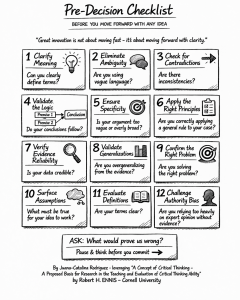
Applying CAT Skills to Innovation – 12 Questions Every Innovator Must Ask Before Moving Forward
To answer the question I often get from changemakers is How do we practice and apply CAT skills to an innovation project? I often said that it is a daily practice, as Critical Thinking isn’t just one skill; it’s a collection of interconnected abilities that work together.
Let’s leverage the Robert H. ENNIS paper, which describes 12 essential abilities, demonstrating that critical thinking is multi-dimensional rather than a single capability, and reflect on how to apply your CAT (Critical Thinking) skills to any project, innovation, or idea.
Here’s a quick breakdown, including some examples that will help you to put each in a real context. I also created a summary cheat so you can practice them.
- Grasping the meaning of a statement. Asking yourself, can you clearly define terms? Example: What does “market opportunity” mean in your project context?
- Judging whether there is ambiguity in a line of reasoning. Are there unclear or double meanings? Example: Does “growth” mean revenue or user base? Or both?
- Judging whether certain statements contradict each other. Are there inconsistencies in the argument? Example: Does the data contradict your hypothesis?
- Judging whether a conclusion follows necessarily. Does the conclusion logically follow? Example: If A = B and B = C, does A = C? and why?
- Judging whether a statement is specific enough. Is your argument too vague or overly broad? Example: “Customers love it” vs. “85% of surveyed customers prefer it.”
- Judging whether a statement is actually the application of a certain principle. Are you correctly applying a general rule to this specific case? Example: “Lowering prices will increase demand.” Does this principle apply in a premium luxury segment, or are there exceptions?
- Judging whether an observation statement is reliable. Can the data or observation be trusted? Example: Was the customer feedback collected from a representative sample, or only from early adopters and internal teams?
- Judging whether an inductive conclusion is warranted. Are you generalizing appropriately from the evidence? Example: Five positive user interviews. Can we conclude that there is strong product-market fit, or is the sample too small and biased?
- Judging whether the problem has been identified. Are we solving the right problem? Example: Are declining sales due to poor product quality, or weak distribution and visibility?
- Judging whether something is an assumption. What must be true for your idea to work? Example: “Users will switch platforms easily.” Is this a tested insight or an unverified assumption about behavior?
- Judging whether a definition is adequate. Is the concept useful and meaningful in this context? Example: How are we defining “innovation or project success”: number of launches, revenue impact, or long-term value creation?
- Judging whether a claim from an authority is acceptable. Are we relying too heavily on expert opinion without evidence? Example: “A senior executive believes this will work” – what data supports this belief?
Great innovation is not just about bold ideas; it is about asking better questions systematically before scaling them.
The Role of Assumptions
A critical thinker must also identify assumptions and define clear hypotheses. Many flawed arguments fail due to unexamined assumptions. Here’s how to tackle them:
- Identify hidden assumptions (gap-fillers in arguments).
- Evaluate whether they are justified.
- Recognize presuppositions embedded in statements.
Purpose Shapes Judgment
Another common question I get from students and clients is: What counts as “enough evidence”?The answer depends on the stakes and purpose.
- Higher standards of evidence are required for decisions that impact large systems, such as defining a strategic pivot for an organization.
- Lower standards may suffice in low-risk contexts, like choosing the color scheme for a presentation.
Critical thinking is situationally calibrated, not absolute. It’s about adapting your approach to the context and stakes at hand.
In summary, for your innovation and leadership lens, here’s what this all means:
- Critical thinking is a system, not intuition. You can learn, train, and practice it to polish your skills.
- Your decision quality depends on: evidence quality, assumption clarity, and context awareness.
- Some of the biggest failure modes are: Ambiguity, hidden assumptions, weak evidence, and misaligned purpose.
At its essence, critical thinking is the disciplined, criteria-based, and context-aware evaluation of statements, grounded in logic, evidence, and purpose.
So, whether you’re tackling a labyrinthine project or sparking the next big innovation, remember: critical thinking isn’t about thinking harder, it’s about thinking smarter. It’s the discipline behind every breakthrough and the superpower that turns uncertainty into opportunity.
Think critically. Innovate boldly. And always, always follow the thread.
Cheers to your next big idea!